
Neuroscience Capstone
Advanced Methods: Psychophysiology
Our Goal
Our psychophysiology lab focused on interoception. The purpose of the study was to examine how interoception relates to decision making, lie detection, empathy, emotion recognition, proprioception, pain tolerance, and more. My area of focus was the connection between interoception and proprioception, however.
What is Interoception?
Interoception broadly defines an individual’s ability to sense the body’s internal state, including elements such as heart rate and temperature.
What is Proprioception?
Proprioception describes an individual’s ability to determine the location of their body in space.
How did we measure interoception?
We used a heartbeat detection task to measure participants’ interoceptive accuracies. We used protocol from the modified Whitehead task, first developed in 1977. Participants were hooked up to three EKG leads. After a five minute adaptation period, the task began. A series of ten tones played out loud, and the participants were asked to identify if the tones were synchronous or asynchronous with their heartbeat. Forty sets of tones played in a random order, with twenty synchronous and twenty asynchronous.
How did we measure proprioception?
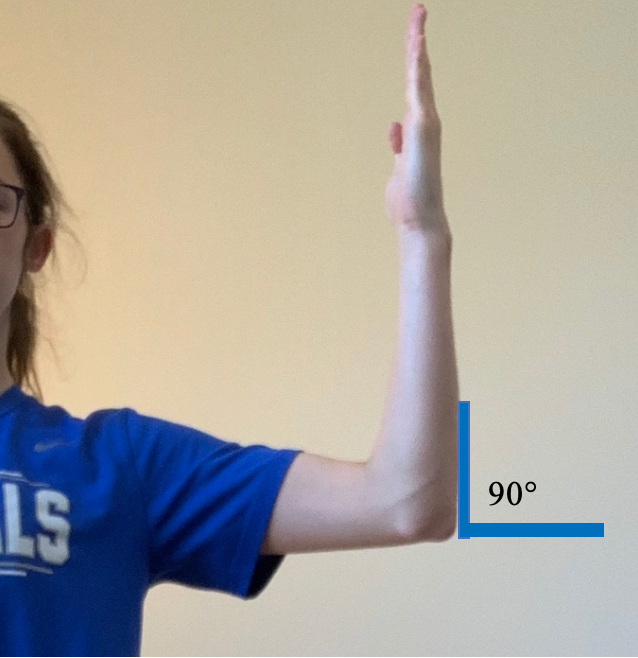
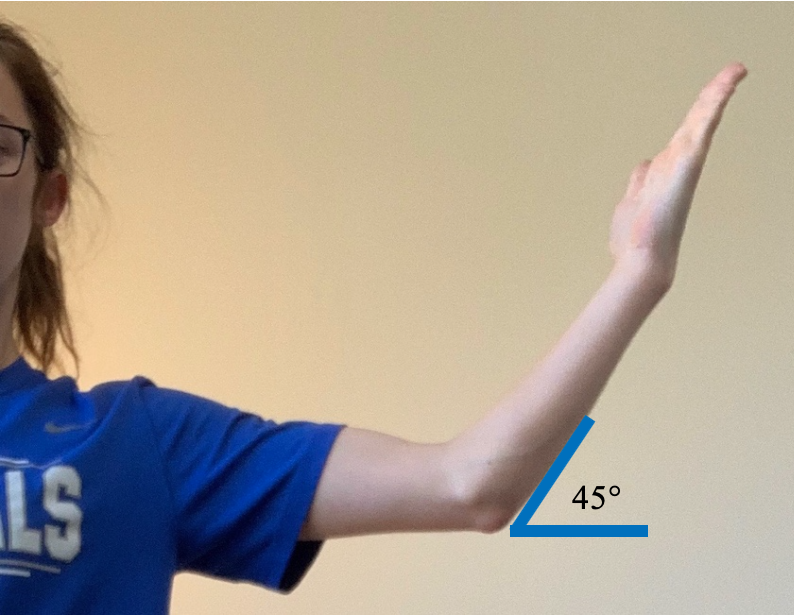
We measured proprioception using a joint position angle task. In this task, participants placed their dominant arm on a flat surface. The researcher moved their arm at the elbow joint to a specified angle of 20, 45, 70, or 90 degrees (examples shown below). The participants held their arm at this angle for five seconds. Then, they were ask to move their arm back to the flat surface. Finally, the participants were asked to replicate the angle again with their arm. The researcher measured the new angle created. The difference between the original angle and the angle generated by the participant was important in calculating the participants’ proprioceptive accuracy score.
What’s the catch?
We studied this relationship in two sub-samples: athletes and non-athletes.
We hypothesized a stronger positive correlation between proprioception and interoception in athletes than in non-athletes.
What did we find?
We found a nearly significant difference in the relationship between interoception and proprioception in athletes and non-athletes. As you can see, our two graphs have different trends. If you want to learn about our results more in depth, take a look at my full report.
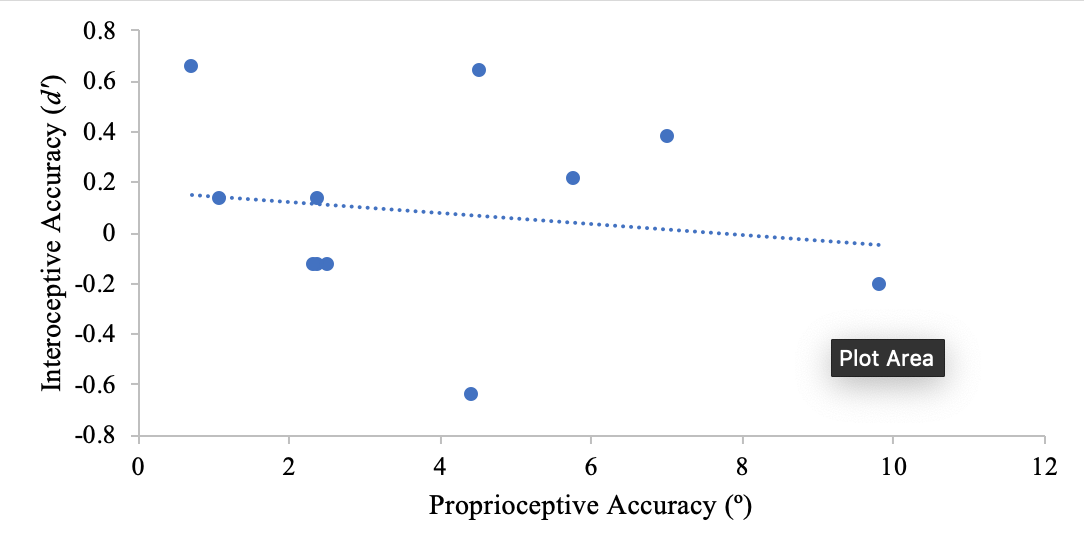
Interoceptive and proprioceptive accuracy in athletes.
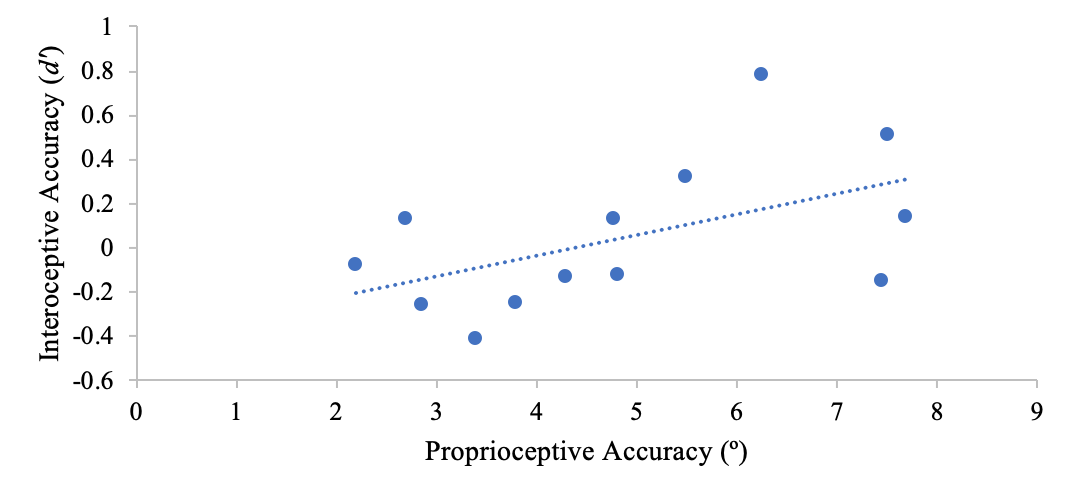
Interoceptive and proprioceptive accuracy in non-athletes.
Want a more in-depth explanation of our research?
Take a look at my full report on the semester-long project!

Dr. Ryan Brindle
Assistant Professor of Cognitive and Behavioral Science
Dr. Brindle was the supervising faculty member at Washington and Lee for this project. To learn more about Dr. Brindle, visit his page on the Washington and Lee University website.